


Evento
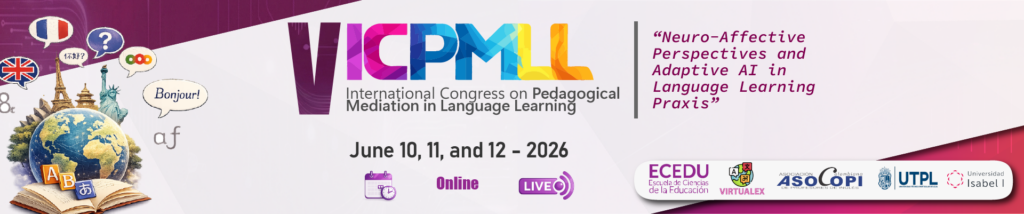
V International Congress on Pedagogical Mediation in Language Learning “Neuro-Affective Perspectives and Adaptive AI in Language Learning Praxis”
This event takes place from June 10, 11, & 12 Online
Be part of the V International Congress on Pedagogical Mediation in Language Learning and share your research with an international academic community. Accepted abstracts will be published in the official conference proceedings. Additionally, contributors may be invited to submit a full research chapter for our forthcoming edited volume, Pedagogical Mediation in the Digital Era: Research and Practices, currently in preparation and scheduled for publication in 2027. Participants may also have the opportunity to publish extended articles in the EducaT Journal or the EducAcción Sentipensante Journal.
Close abstract submission
May 8, 2026
Acceptance notification
May 11, 2026
Full paper submission window
May 12 – 30, 2026
Selection of papers for book chapter & journal
May 26 – June 30, 2026
PRESENTATION
The International Congress on Pedagogical Mediation in Language Learning (ICPMLL) has established itself, throughout its four previous editions, as one of the epicenters of intellectual debate and pedagogical innovation in the field of language teaching in Colombia and Latin America. Since its launch in 2022, under the leadership of the School of Education Sciences (ECEDU), the Master’s Program in Pedagogical Mediation in English Learning, and the VIRTUALEX research group at the National Open and Distance University (UNAD), the event has followed an upward trajectory in understanding how technology and pedagogy intertwine to transform educational realities. This fifth edition not only represents a commemorative milestone but also marks a paradigmatic shift by proposing a conceptual triad that responds to the most complex challenges of the 21st century: neuroscience, the affective dimension, and adaptive artificial intelligence.
The relevance of pedagogical mediation in language learning lies in its ability to act as a catalyst between the object of knowledge and the learner. In an educational ecosystem increasingly mediated by digital interfaces, the role of the teacher and the instructional designer has ceased to be that of mere transmitters of information and has instead become that of architects of learning experiences. However, this architecture cannot be static or merely intuitive. The foundation of the fifth edition of the congress rests on the premise that effective mediation must be grounded in scientific evidence about the functioning of the human brain, the role of the affective dimension and learner well-being, and the scope of AI-mediated instruction in language learning. The convergence of these thematic axes positions the ICPMLL as a pioneering event that not only discusses the future of language education but also provides the theoretical and practical tools to build it from a scientific, humanistic, and technological perspective. It is, in essence, a call to the academic community to lead the transformation of educational practice under a model that recognizes that the brain that learns is a brain that feels, and that the most advanced technology is that which serves human well-being.
GENERAL OBJECTIVE
The central objective of the V International Congress on Pedagogical Mediation in Language Learning is to consolidate a high-level academic and scientific exchange space that enables the analysis and integration of perspectives from cognitive neuroscience, the affective dimension, and adaptive artificial intelligence in pedagogical mediation for language learning. The congress seeks to foster the production of applied knowledge and the systematization of experiences that demonstrate how the convergence of these fields enhances learning effectiveness, promotes student well-being, and redefines the teaching role in digital and hybrid educational environments.
SPECIFIC OBJECTIVES
- To democratize access to cutting-edge scientific knowledge, facilitating the social dissemination of findings in neuroeducation and artificial intelligence among teachers, researchers, and diverse educational communities, in order to reduce the gap between academic production and pedagogical practice in vulnerable territories.
- To promote the social appropriation of knowledge through the creation of transnational collaboration networks that allow participants to exchange successful mediation experiences and innovative solutions, fostering a tangible impact on improving the educational quality of local and international communities.
- To critically evaluate the impact of adaptive technologies and language models, analyzing their capacity to personalize learning and manage students’ cognitive and emotional load, ensuring an ethical, inclusive, and human-centered pedagogical mediation.
International and National Speakers

Educational Neuroscience Hub
Visiting Lecturer University of Malta
Honorary Research Fellow UCL

Associate Professor
Centre for Academic Literacies and English Communication Skills (C-ALECS)
Malta

Professor of Second Language Acquisition
IOE – Culture, Communication & Media

PhD Candidate at University of Exeter
Exeter, United Kingdom

Educational Sciences Department
University of the Basque Country
Spain

Analista de Innovación en la UTPL
Líder del XR LAB y el Club de Realidad Virtual
Ecuador

Master of Education in English Didactics
Universidad Católica Luis Amigo»
Thematic Axes
Axis 1: Pedagogical Mediation in Language Learning
This axis explores pedagogical mediation as a core dimension of language education, highlighting the teacher’s role as a facilitator of meaningful, autonomous, and context‑sensitive learning experiences. It examines how mediation practices respond to the complexity of today’s hybrid, diverse, and AI‑influenced educational environments.
Sublines:
• Scaffolding and mediation in virtual and hybrid settings
• The teacher as mediator in contexts of digital information overload
• Curriculum design grounded in pedagogical mediation
• Collaborative learning and peer mediation in intercultural environments
• Formative assessment as mediation for autonomy
• Effects of pedagogical mediation on communicative competence
Axis 2: Neuroscience and Language Learning
This axis integrates advances in cognitive neuroscience with language pedagogy, focusing on how brain mechanisms and neuro-affective processes influence language acquisition. It promotes evidence-based teaching practices aligned with attention, memory, neuroplasticity, and multisensory learning.
Sublines:
• Executive functions and second language acquisition.
• Neuroplasticity and sensitive periods in language learning.
• Managing cognitive load in instructional design.
• Brain mechanisms of memory in bilingualism.
• Multisensory teaching strategies informed by neuroscience.
• Attention and processing of linguistic input.
Axis 3: Affective Dimensions & Learner Well-Being
This axis addresses the emotional foundations of language learning, recognizing the impact of anxiety, enjoyment, identity, and motivation on learner performance and persistence. It promotes pedagogical models that integrate emotional intelligence, well‑being, and positive psychology into language learning.
Sublines:
• Managing Foreign Language Anxiety (FLA) in digital contexts.
• Emotional intelligence and self-regulation strategies.
• Resilience and growth mindset in language learners.
• Identity, belonging, and intrinsic motivation.
• Mediation strategies for well‑being and mental health.
• Affective considerations in the shift from in‑person to virtual learning.
Axis 4: AI-Mediated, Adaptive & Data-Driven Language Learning
This axis examines the transformative impact of generative and adaptive AI on language education. It explores intelligent tutoring systems, LLM‑supported learning, analytics‑driven personalization, and the ethical and pedagogical implications of AI integration in teaching and assessment.
Sublines:
• Large Language Models (LLMs) in teaching practice.
• Intelligent Tutoring Systems (ITS) for personalized instruction.
• Learning analytics for automated, real‑time feedback.
• Ethics, bias, and equity in educational AI.
• Designing adaptive learning environments using performance data.
• Prompt engineering for teachers and AI‑based mediation.
• Adaptive assessment and individualized progress tracking.